AI-assisted Revenue Cloud delivery, in practice
This is the first post on the new futuresimple.nl, and it felt right to start with the thing that has changed most in how I work: AI. Not AI as a feature on a slide, but AI inside the delivery itself - in how a Revenue Cloud implementation gets researched, designed, built, tested and handed over.
I have been in telecoms systems since 2006 and in quote-to-cash since 2016, at Netcracker, Vlocity, Salesforce and ideaHelix. The turning point was a program for a dental insurer. It was an industry new to me, with few people who understood both the business and the technology, the product itself was new, and the goal was extremely ambitious. By lucky coincidence, tools this powerful arrived at exactly that moment, and that program is where I started building the Software factory to make sure it succeeded.
Where the time goes in a Revenue Cloud program
If you have read my earlier posts, you know I see the product catalog as the “sacred book” of a catalog-driven business: it defines what the company sells, how it delivers it and how it earns from it. The decisions behind it - the product model, the offers and bundles, the pricing and compatibility rules, who owns what - are where a program succeeds or fails.
Typing those decisions into an org is a different matter. A Revenue Cloud implementation carries a lot of repetitive work: catalog records, attributes, prices and rules configured one by one, then documented, then tested. In my experience, most of the time goes into the foundation: the one-time preparation, done up front, that makes the platform able to run the configuration and deliver the business requirements at all. And it does not stop there. Catalog management then becomes iterative, continuous work, carried out in the end by IT and the business together. None of it is unimportant, but none of it is where your money should go.
I have been chipping away at this for a while. EPC on Steroids, a Google Sheets template for designing a Communications Cloud product catalog and pushing it to Salesforce in one step, came from exactly that frustration. It is open source, and it grew into Catalogic, which prepares product catalog data in a spreadsheet and loads it into Salesforce Revenue Cloud. AI takes the same idea much further.
The Software factory
The Software factory is my repeatable setup of methodology, agents and automation. It builds classic Salesforce implementations and Agentforce work from written specifications, on a shared foundation of platform knowledge and industry expertise. It takes on the repetitive configuration and documentation, so more of the budget goes into design.
It grew out of working with extremely bright engineers and delivery managers at ideaHelix and beyond, and it borrows proven practice from software engineering, such as Matt Pocock’s AI Hero. The question behind it was simple: how do we deliver more capabilities with fewer people and less time, still within the boundaries of a typical Salesforce implementation project?
So we took a fresh look not just at the build, but at the whole process, end to end. We could not start from scratch, but we did not want to be held back by the classic processes and tools either. The result is built in layers.
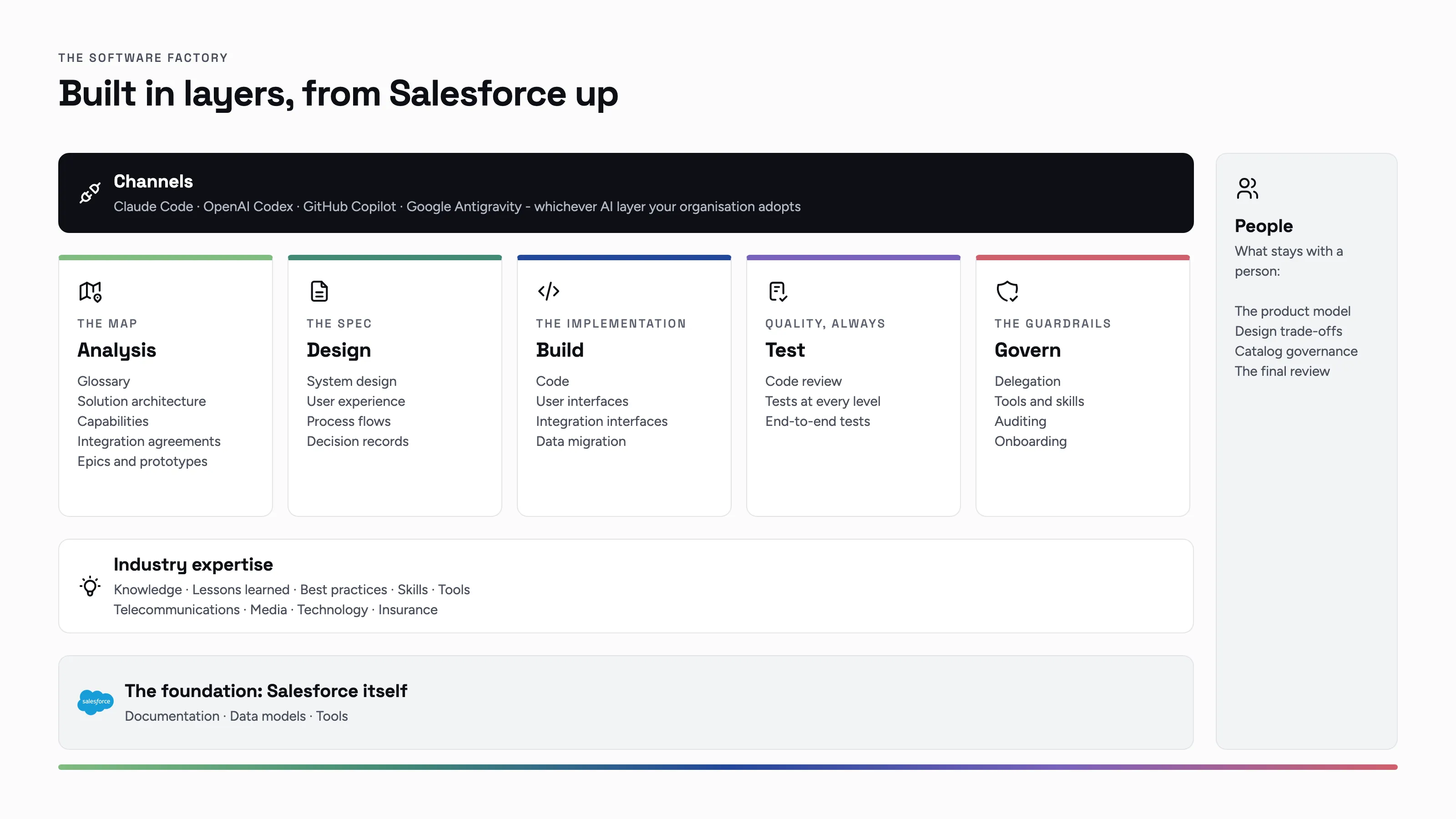
It is how I work, not something I sell separately. You do not buy the Software factory; you get a Revenue Cloud implementation, a product catalog design or an architect on your team, delivered with it.
The foundation: Salesforce itself
At the bottom sits the platform: Salesforce documentation, data models and tools. Everything above it is built on how Salesforce actually works, not on how we would like it to work.
This matters more with agents, not less. A Salesforce implementation has to be grounded in Salesforce’s own documentation, data models and recommended patterns: the standard objects, the platform’s features and the way they are meant to fit together. Agents left to their own devices will happily solve every problem from scratch, and the result is piles of custom code, very, very fast. Grounded in the platform, they reach for what Salesforce already does first, and write code only where it genuinely adds something.
Industry expertise
On top of that comes a layer of industry expertise: the knowledge, lessons learned, proven patterns, skills and tools from years of quote-to-cash work in telecommunications, media, technology and insurance.
Salesforce is a platform, a product. It is not a solution. A solution is what you get when a product is used to solve a real customer’s problem, in their real context, with their real limitations. Salesforce even publishes its own recommendations, but you only really learn by doing: which data model holds up at scale, where a standard process stops fitting the business, what breaks at go-live. That practical knowledge and experience is a second layer of grounding on top of the platform, and the agents work from both.
Analysis: the map
The first stage draws the map: the glossary, the capabilities, the modules and the epics. Requirements are gathered, maintained and updated in one place, so people and agents work from the same map.
Prototyping is a big part of this stage. Quick prototypes, built in line with the Salesforce user experience, let people react to something they can see and click rather than a list of requirements. That dramatically speeds up agreeing what is actually needed.
Design: the spec
The map becomes a specification: system design, user experience and process flows. Agents build from what is written down, so the written design is not paperwork for later: it is the input. Before the build starts, you get a solution design you can read - product model, quote and order flows, integrations and data model - and we agree it together.
One point here is critical: we write down architecture decisions as part of the process. Each one records not only what we decided, but why, and why we did not choose the other options. This turned out to be extremely important for keeping the team in sync. With many people working on many modules, and not always talking to each other, there are always gaps somewhere. The decision record closes them.
Build: the implementation
The spec becomes the implementation: code, content and the other deliverables, built by people and agents together. Managing environments was particularly tricky to get right.
One requirement is crucial here: consistent, high-quality output that follows Salesforce’s own guidance. Without it, you produce a lot of code very fast. That does not look like a big problem at first, but it will bite you later. So start slow, and start smart.
Test: quality at the heart of the project, always
Thorough code review and testing are embedded in the process at every level, from the individual change to continuous integration. Test scripts are generated alongside the build, not written at the end when the budget is gone. An agent is not finished until there is a test that says it works.
While agents are fairly competent at unit tests and at testing within a single module, the methodology puts its weight on end-to-end tests, close to the ones real people run during acceptance, to make sure the solution meets the quality gates at every level.
Govern: the guardrails
The last stage is the somewhat boring one, and a crucial one: making sure AI is used efficiently, safely and in a way people can trust. This is where the agents’ involvement is kept under control. The team agrees what can be delegated to agents and what cannot, which tools and skills to use, and where the line sits for each customer. It covers auditing, so you can always see what an agent did and why. And it covers onboarding, so new people on the team work the same way from their first day.
None of this is glamorous, but without it, the speed of the other stages turns into risk.
Channels
The top layer is the channel: the AI tool the work actually runs in.
We started with the idea that we could unify the tooling across the whole implementation team. We quickly realised this is far from easy. Customers approve only certain agentic tools, and often not the ones we use. Engineers have different laptops and their own preferences in coding agents. There is no easy way out of this.
So the methodology is designed to be platform agnostic: it works with Claude Code, OpenAI Codex, GitHub Copilot or Google Antigravity - whichever your organisation is adopting as its AI layer.
What stays with a person
People remain a big part of the Software factory, in the framework and in the methodology alike. They are not going anywhere, and they often become the bottleneck. So we are working out what can be delegated to agents, what is negotiable, and what absolutely has to stay with a person - without making that person the bottleneck.
Some things I do not hand to an agent: the product model, the trade-offs in the solution design, the governance that decides who can change what in the catalog, and the final review. These are judgement calls, and they are what you are paying a senior architect for.
What it means for you
For a Salesforce customer, it means more of your budget goes into design, and the person you talk to is the person who builds it. For a Partner consultancy, it means I can bring the agents and automation of the Software factory onto your engagement where your team wants them, and stay out of the way where it does not.
You can read more about how I work with AI on the About page, or see what a Salesforce implementation with us includes.
AI is changing how businesses operate, how value is delivered and how fast. We practise it every day and build up the knowledge as we go. If you want to get to the value faster, let’s talk.